
09-11-2025
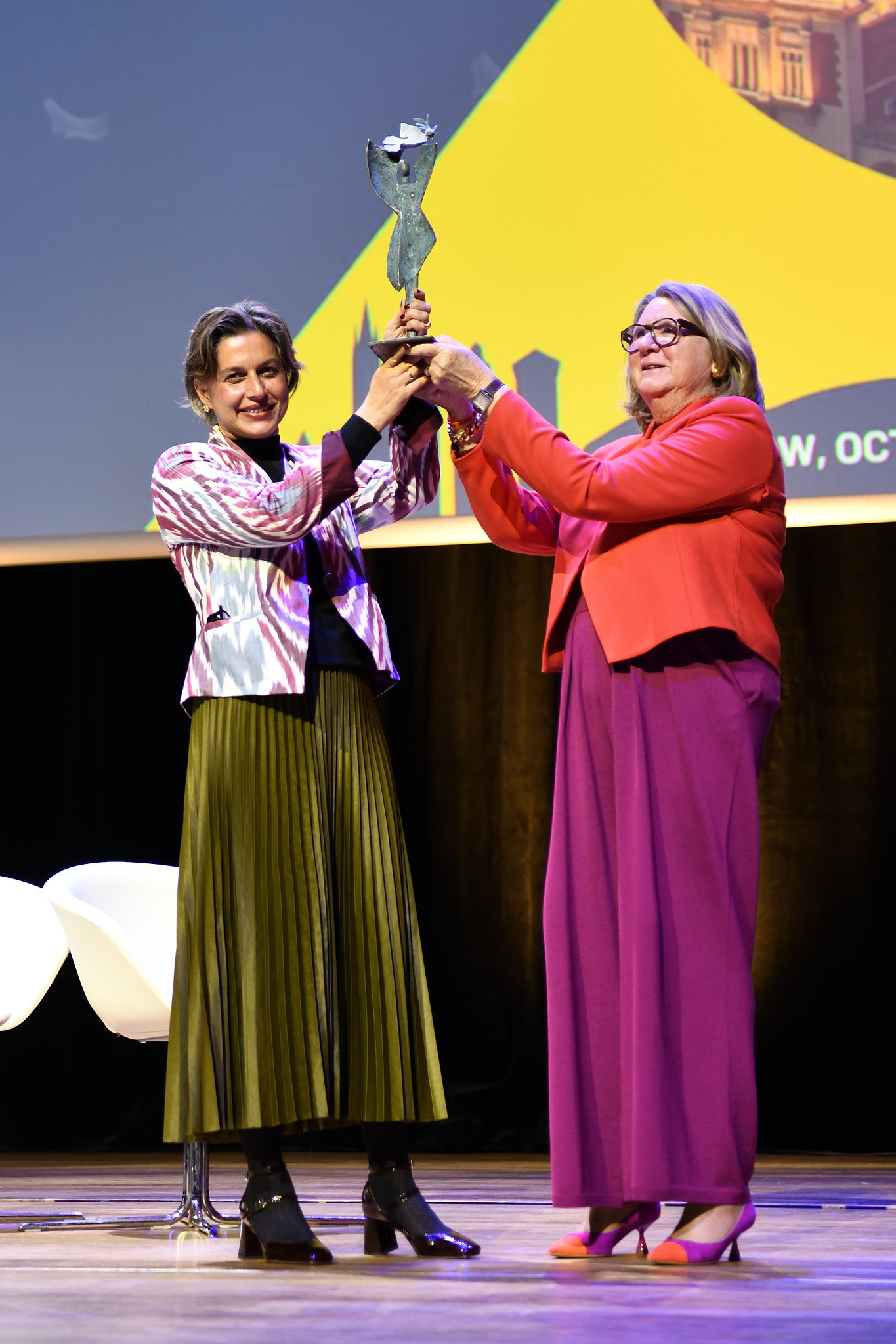
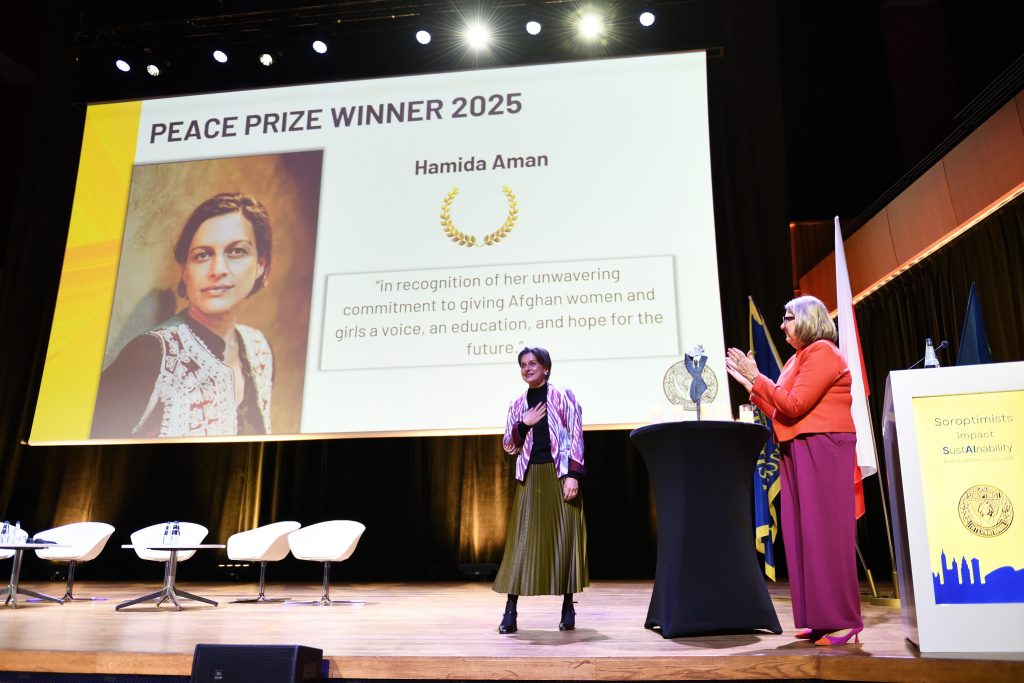
Hamida Aman ontvangt de Soroptimist International of Europe Peace Prize 2025
Tijdens het congres van Soroptimist International of Europe in Krakau van 23-25 oktober is de Soroptimist International of Europe (SIE) Peace Prize 2025 toegekend aan Hamida Aman, oprichter van Radio Begum in Afghanistan. De prijs eert haar “onwankelbare inzet om Afghaanse vrouwen en meisjes een stem, onderwijs en hoop voor de toekomst te geven.” De SIE Peace Prize 2025 bekroont een vrouw wier levensverhaal symbool staat voor moed, veerkracht en hoop. Hamida werd voorgedragen door SI Club Deauville-Trouville (Frankrijk).
De uitreiking vond plaats tijdens de plenaire zitting van het SIE-congres, in aanwezigheid van honderden Soroptimisten uit heel Europa. Carolien Demey, Immediate Past President van SIE en voorzitter van de Peace Prize-jury, hield een indrukwekkende speech waarin zij alle Soroptimisten opriep om de stem van de laureaten te versterken.
“Vrede is niet enkel de afwezigheid van conflict.
Vrede is de aanwezigheid van rechtvaardigheid en de bescherming van mensenrechten.
Het is het dagelijkse werk van de mensheid — het bouwen aan waardigheid, hoop en medemenselijkheid.”
“Wij mogen dan niet altijd de vrouwen op de barricaden zijn,
maar wij zijn — in hun woorden — de krachtige fluisteraars,
de vrouwen die in stilte rechtvaardigheid bouwen.”
Een stem voor vrouwen in Afghanistan
In ballingschap groeide ze op met de dierbare herinneringen van haar ouders aan Afghanistan: een land van poëzie, waardigheid en kracht. Één zin van haar vader bleef haar altijd bij:
“Vergeet nooit – wat je hier leert, moet op een dag je land ten goede komen.”
Die woorden werden haar kompas. Na haar studie literatuur in Zwitserland keerde ze in 2002 terug naar Afghanistan – niet als bezoeker, maar als bouwer.
Met de oprichting van Awaz Communication, een mediabedrijf dat jonge Afghanen opleidt en werk biedt, gaf ze vrouwen en mannen de middelen om hun eigen verhalen te vertellen en bij te dragen aan de wederopbouw van hun land met kennis en creativiteit.
Ruim twintig jaar lang stond ze in het hart van de heropleving van Afghanistan. Ze zag hoe vrouwen zich lieten horen, toegang kregen tot onderwijs, en hun dromen durfden te volgen.
Toen in 2021 de Taliban terugkeerden, verlieten velen het land. Zij bleef.
Ze koos voor solidariteit boven stilte, voor moed boven angst.
Met de krachtigste wapens die er bestaan – onderwijs, empathie en stem – blijft ze strijden tegen een van de meest onderdrukkende patriarchale regimes ter wereld.
Hamida Aman richtte Radio Begum op in 2021, midden in die periode van politieke onzekerheid en onderdrukking van vrouwen in Afghanistan. Met een klein team van jonge vrouwen begon ze te zenden over gezondheid, onderwijs en rechten. Inmiddels is het initiatief uitgegroeid tot een multimedia-organisatie met radio, televisie en een digitale onderwijsomgeving: Begum Academy.
Hamida’s team blijft werken — vaak vanuit ballingschap — om vrouwen te bereiken via satelliet, offline lesmodules en lokale partners. De organisatie bereikt inmiddels tienduizenden meisjes en vrouwen met lessen, advies en hoop.
Onder haar leiding groeide Radio Begum uit tot een multimediaal netwerk dat duizenden vrouwen en meisjes bereikt. Via radio, televisie en offline lesmateriaal biedt haar team informatie, onderwijs en hoop – maar ook waardigheid, troost en licht in een samenleving waar vrouwenrechten systematisch worden ontkend.
In haar dankwoord vertelde Hamida dat zij de prijs in ontvangst neemt namens alle vrouwen van Begum en namens de miljoenen Afghaanse vrouwen “die we niet mogen vergeten en die blijven vechten om hun fundamentele rechten terug te krijgen.”
De jury en erevermeldingen
De internationale jury, samengesteld door Carolien Demey, bestond uit vooraanstaande deskundigen op het gebied van recht, mensenrechten en internationale samenwerking:
- Prof. dr. Phoebe Okowa, lid van de VN-Commissie voor Internationaal Recht en kandidaat-rechter bij het Internationaal Gerechtshof;
- Silvana Arbia, voormalig hoofdaanklager bij het Rwanda-tribunaal en zelf Peace Prize-winnares (2013);
- Nicole Ameline, voormalig voorzitter van het CEDAW-comité en lid van de VN-Mensenrechtenraad;
- Michael Møller, voormalig directeur-generaal van het VN-kantoor in Genève en bestuurslid van de Kofi Annan Foundation.
Naast de hoofdprijs kende de jury twee speciale erkenningen toe:
- Patsy Sörensen (inzending van SI Club Gent-Scaldilys, België), voor haar pionierswerk tegen mensenhandel met Payoke;
- Liliana Segre (inzending van SI Italië), Holocaust-overlevende en senator voor het leven in Italië, voor haar levenslange inzet tegen intolerantie en racisme.
Lees ook het nieuwsbericht van SIE over de SIE Peace Prize 2025.
Volledige speech van Carolien Demey – SIE Peace Prize 2025, Krakau
Not a single soul in this room has not been reading, speaking, thinking, or debating about peace in these past years.
After eight years, we once again have a Peace Prize Laureate at a Soroptimist Congress.
I feel deeply honoured to have been entrusted with this task.
We often speak of peace as the opposite of war.
But peace is not merely the absence of conflict.
Peace is the presence of justice.
It is the protection of human rights.
It is the ongoing labour of humanity—the daily effort to build justice, dignity, and hope that endures beyond our lifetimes.
Peacemaking is not only about resolving conflicts—it is about preventing them by laying the foundations of justice and compassion.
I started my task to find this year’s Peace Prize Laureate by composing the jury, so I had to reach deep into my network—to form a high-level jury of professionals who possess
deep knowledge of the regions involved,
who understand the politically sensitive dynamics,
and the complexities that reach beyond our own federation’s experience and framework.
And for all those times your club members, your board members, your union members sometimes feel that Soroptimist volunteering can be time-consuming, I want you to meet these jurors—not Soroptimists themselves—who still dedicated their time and energy, on a strictly voluntary basis, despite their full agendas, to help us find a laureate we can all proudly stand behind.
Let me present them:
I found the first jury member through the Amal Clooney Foundation, who sadly don’t allow their board members to jury in other organisations, but put me on the way –
Dr Phoebe Okawa, Professor of Public International Law, LLB (Nairobi), BCL (Oxon), DPhil (Oxon), Advocate (High Court of Kenya), Associate Member of the Institut de Droit International, member Permanent Court of Arbitration at The Hague (2017–2022). In 2021, elected to the United Nations International Law Commission—the first African woman in the Commission’s history, now candidate Judge at the International Court of Justice.
Silvana Arbia, the only one to respond at first demand—our Peace Prize winner in Berlin—praised for her role in the Rwanda Tribunal.
Nicole Ameline, well known through CEDAW, just elected Member of the Advisory Committee of the Human Rights Council, former Chair of the Defence and Security Committee of the NATO Parliamentary Assembly.
Michael Møller, former Under-Secretary-General of the United Nations, former Director General of the UN Office at Geneva, Board Member of the Kofi Annan Foundation—a true feminist who was deeply engaged and committed and generously offered to share the Peace Prize press release with his entire network of at least 7,000 people.
And now I ask you: will you do the same?
Will you engage in this simple but powerful act of advocacy?
If you will, please raise your hand—come on, ladies!
This is how we can make our movement known and recognised—by amplifying the voices of peace together.
The jury applauded all your efforts, but also came with a clear message for us all.
They urged us to be more conscious of how relevant we can truly be.
They literally said: we could do better.
We may not be known as the women on the barricades, but we are—or can be—“the powerful whisperers,” the influencers who, through our ongoing labour of humanity, build justice and dignity in quiet yet transformative ways.
I took the engagement up to bring you this message.
But there is more, as our focus was on assigning a laureate whose current work embodies peace—a sustainable peace worker—for whom the prize would be an incentive to reach further.
The jury was triggered to also honour the lifetime achievements of two older remarkable women:
Patsy Sorensen, candidate of Belgian Club Ghent Scaldis, retired from Payoke, in recognition of her pioneering fight against human trafficking—sadly more relevant today than ever before.
Liliana Segre, candidate of the Italian Union, 95 years old, Holocaust survivor and Senator for Life in Italy, honoured for her lifelong fight against intolerance and racism with numerous awards in France and Germany.
What they have in common is that both needed police protection at a certain time in their lives.
And now, let me introduce this year’s Peace Prize Laureate.
Tonight, we honour a woman whose life tells the story of courage, resilience, and hope.
She was born in Kabul, Afghanistan.
As a little girl, she was forced to flee her country with her family—leaving behind everything except the love of her homeland.
In exile, she grew up with her parents’ cherished memories of Afghanistan—a country of poetry, dignity, and strength.
One sentence from her father stayed with her forever:
“Never forget—whatever you learn here, it must one day serve your country.”
Those words became her compass.
After studying literature in Switzerland, she returned to Afghanistan in 2002—not as a visitor, but as a builder.
Through Awaz Communication, the media company she founded, she trained and employed hundreds of young Afghan men and women, empowering a new generation to tell their own stories and rebuild their country with knowledge and creativity.
For two decades, she was at the heart of Afghanistan’s rebirth—witnessing the rise of women’s voices, their access to education, their hopes, and their dreams.
Then came 2021.
When the Taliban returned, many left.
But she stayed—standing by her sisters, choosing solidarity over silence, courage over fear.
She continues to fight the most repressive patriarchy with the most powerful weapons: education, empathy, and voice.
Her work now reaches thousands of women and girls deprived of their rights—offering not only information, but dignity, comfort, and light.
Her journey reminds us that peace is not given—
it is built.
Word by word.
Hand in hand.
Sister by sister.
Please join me in welcoming the SIE Peace Prize Laureate 2025,
the candidate of SI Deauville, France—Miss Hamida Aman.